The Global Society of Online Literacy Educators
Issue No. 25 November 2026
President’s Message

GSOLE is for friends, old and new.

Dear GSOLE Members,

Happy November All!

We are all in the thick of the semester. We all appreciated the extra hour that daylight savings gave us, but I am sure that we are wishing there could be more extra hours as we stare down the (digital) pile of grading while the semester’s clock ticks down. Yet soon many of us will be taking a respite to celebrate what we are thankful for–and for many of us that is family and friends.

And GSOLE is for friends, old and new.

One thing I have heard over and over again during the last few years from GSOLE members is how our organization, despite its mostly online presence, is where many have made friends in the field. Mary Lourdes, our vice president, has often been GSOLE’s greatest advocate, explaining to potential members how the organization has given her a community of teachers and researchers with similar scholarly interests with whom she can share her ideas and practices, as well as collaborate with. These friendships go beyond the academic halls; I am grateful that Scott, a past president, has come out to my partner’s art show when we were in Philadelphia.

But I also know that we are lamenting that our traditional meeting space, the meeting of the Conference on College Composition and Communication will be ending after 2027. As we create ways to connect with old friends, this moment also gives us an opportunity to make new friends.

The November Pledge In that spirit, I want to ask GSOLE members to make a pledge. I want you to recruit one new member for the organization.

We know the de-chartering of the CCCC has left many instructors and scholars who employ and think about online pedagogical methods–like teaching through Learning Management Systems (LMSs; such as Canvas and Moodle)–without an academic home. Reach out to them. We know people in our departments and across our campus who teach writing using online pedagogical methods but do not feel like they have been appropriately prepared or have had sufficient support. Reach out to them.

Point these individuals to the many text-based resources that GSOLE has, such as the ROLE journal (https://gsole.org/olor/role), the OLOR Effective Practices (https://gsole.org/olor/ep), Just in Time archives (https://gsole.org/jit). Or invite them to a live event, such as the December 1st Cyber Salon (https://glosole.wildapricot.org/Sys/Login?ReturnUrl=%2fcyber-salon%2frooms), the February 3rd-5th GSOLE Conference (https://gsole.org/2027-conference-home) with plenary speakers Kofi Adisa, Amy Cicchino, and Jessie Borgman, or the February 12th Webinar, “Fostering a Community of Readers through Social Annotation Tools” (https://gsole.org/webinars/2026-2027-series). And remind them how affordable our membership and fees are.

GSOLE is also making a new friend, Computers and Writing (or the 7Cs committee of the CCCC). With the looming absence of the CCCC, we have been working with Charles Woods and Wendi Sierra to support each other and to see how these two scholarly bodies can collaborate to support instructors, scholars, and–ultimately–students in the field of writing studies. As an organization, we have a lot of work to do, and the more we can share this labor with the many capable writing studies practitioners, the more we can accomplish.

I look forward to meeting your friends.
Best,

Kevin DePew, GSOLE President

kdepew@odu.edu

Upcoming Event

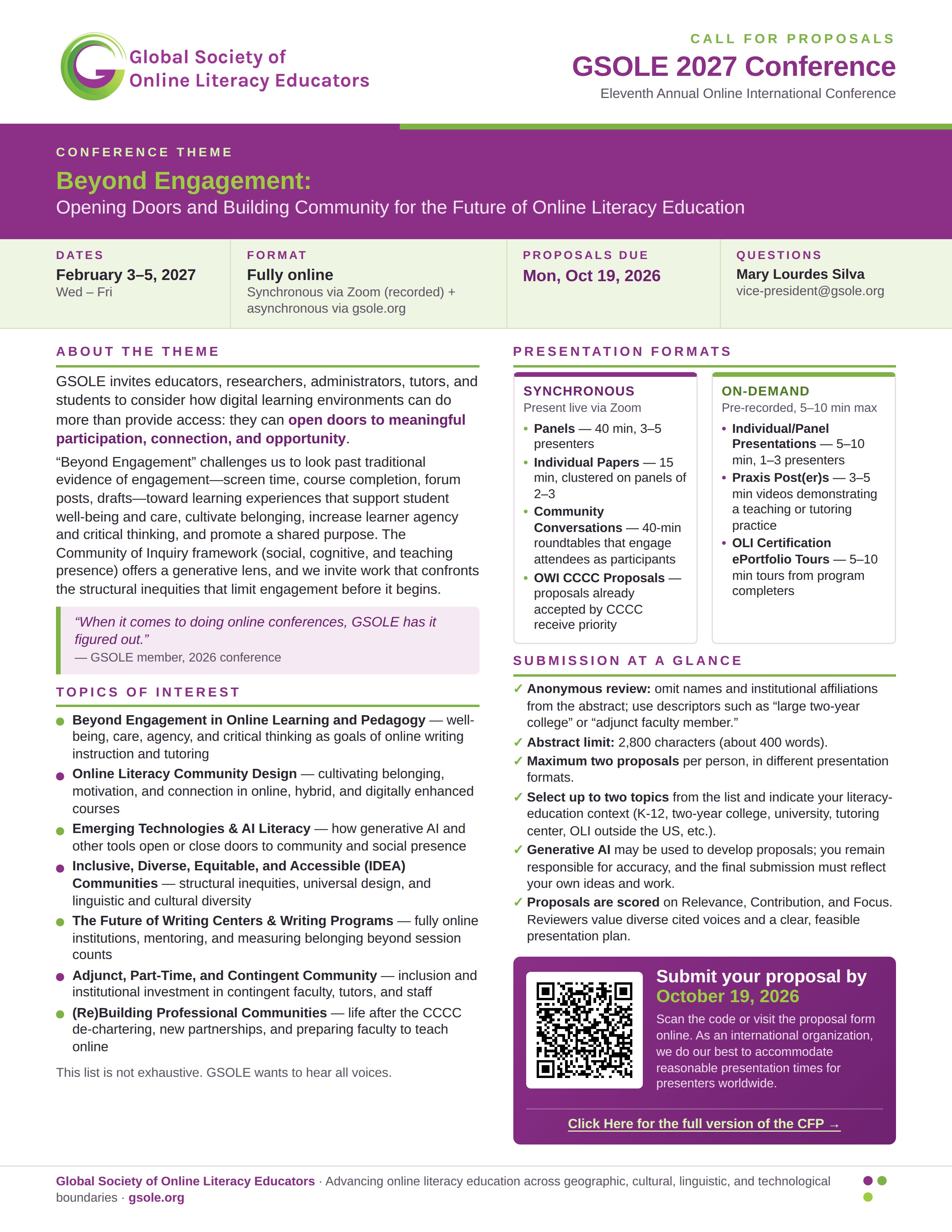
Call for Papers: GSOLE Conference

Call for Proposals flyer for the GSOLE 2027 Conference, the Eleventh Annual Online International Conference. Theme: Beyond Engagement: Opening Doors and Building Community for the Future of Online Literacy Education. Dates: February 3–5, 2027, fully online (synchronous via Zoom plus asynchronous via gsole.org). Proposals due Monday, October 19, 2026. Questions to Mary Lourdes Silva, vice-president@gsole.org. Includes the theme description, topics of interest, synchronous and on-demand presentation formats, submission guidelines, and a QR code to submit a proposal.

JPG image · 1.4 MB

Call for Contributions

Call for OLOR Reviews Contributions

We are excited to invite you to review for OLOR Reviews, a section of our Online Literacy Open Resources. This is not only a great opportunity to engage with GSOLE Editors, but a wonderful venue to publish in the OLI community.

Here is the current list of works for which we’re seeking reviewers:

All reviewers are provided with a free copy of the book they are reviewing, when possible. If you would like to review a book on this list or propose one not on this list, please email OLOR Reviews editor, Dr. Eric Camarillo at ericcamarillogarza@gmail.com.

If you have never published a review but are interested, Eric is happy to help and provide feedback and mentorship.

What is the Format for an OLOR Review?

These reviews are brief, typically 750-1000 words. The structure is summarized below:

  1. Title reflecting review focus
  2. Pithy overview
  3. Body of review (key information from sections with some quotes), distinctiveness of the book, contribution to literacy studies
  4. Weaknesses (if any)
  5. Conclusion

Example reviews are available for your viewing at https://gsole.org/olor/reviews. We recommend viewing recent reviews by Cat Williams-Monardes and Brian Harrell.

We hope to hear from you!

GSOLE Webinar Series

GSOLE Webinar: “Fostering a Community of Readers through Social Annotation Tools”

Webinar LeadersLogan Bearden, Kevin DePew, Janine Morris, & Meghan Velez
Date of WebinarFebruary 12, 2027 from 12:00-1:00 pm EDT

Overview

Born from a well-attended Engaged Experience session at the 2026 CCCC, this webinar responds to the increasing need to teach students across all levels and modalities how to engage with texts, both in general and as artifacts of their disciplinary conversations. While there is a long history of reading instruction in writing studies (Haas; Sullivan, et al.; Lamb and Parrott; Carillo, and Horning), the increased literacy load in online writing courses suggests a need for teaching reading specifically in digital modalities; one way to do this is by leveraging the affordances of social annotation applications (e.g., Perusall, Google Docs).

This webinar will focus on social annotation activities facilitators have used with Google Docs and Perusall for literacy instruction in face-to-face, hybrid, and fully online courses. Social annotation practices have encouraged students to engage in Haas’ rhetorical reading–or going beyond just reading and deciphering the words contained in the text and understanding how text works to impact the context from which it was created. Moreover, social annotation activities can productively disrupt traditional discussion board or reading response pedagogies in which discussion prompts feel removed from the text or the ways that students have engaged with the text. Rather than searching for “the correct reading,” social annotations can encourage authentic, dynamic reading practices and foster collaboration and social presence in online courses, contributing to a community of practice.

The webinar will begin with a brief discussion of participants’ experiences assigning readings and annotations in their classes. Then, facilitators will provide participants with a comparative introduction of popular social annotation applications (focusing on Perusall and Google Docs) with a focus on how their affordances enhance literacy learning in online contexts.

Following this overview, the second half of the webinar will provide participants with different strategies that the presenters have used in their own classes. Topics covered in these brief pedagogical showcases, include...

  1. Getting started with social annotation;
  2. Making reading practices visible;
  3. Fostering community;
  4. Disrupting discussion boards.

Guided by the facilitators, participants will have an opportunity to socially annotate a document in a chosen platform to experience what their students will do when using this tool. After using one of the tools, the participants will be given the opportunity to reflect on what they have learned and experienced in the webinar about social annotation tools and how they would specifically adopt them for the media in their courses. The webinar will end with participants sharing out their reflections and asking questions of the facilitators.

Participants will gain...

  • A comparative introduction to the affordances and limitations of various social annotation platforms, including accessibility and multimodal features;
  • Ideas for innovating the way reading is included in their online writing courses;
  • Connections with other instructors using similar technologies;
  • Practical assignments and activities that they can include in their own courses;
  • A sketch of how they will adopt social annotation tools to their courses.

Registration Information:

  • Free for GSOLE members; register here
  • $15 for non-members
  • Become a member! ($30 regular; $20 students/contingent)
Cyber Salon

GSOLE Hosts Regular Salon Space for Its Members

Join us for regular Salon events, spaces where you can informally gather to talk about timely topics with other GSOLE members and online literacy educators. These events take place on the first Tuesday of every month and are open to anyone, regardless of GSOLE membership status.

Come with your own online writing concerns. Or we can discuss the President’s Message above.

Publishing Opportunities

Publish with GSOLE

Consider publishing in one of GSOLE’s three Online Literacy Open Resource (OLOR) journals:

(peer-reviewed)

publishes brief, practical articles sharing teaching strategies for online, hybrid, and digitally enhanced learning.

(peer-reviewed)

publishes original research and scholarship in literacy-based online education.

publishes reviews of books and technologies related to online literacy education.

Leadership Opportunity

New Position: GSOLE Archivist

GSOLE has created an archivist position to help organize and store its content for efficient future retrieval. This is a great position for anyone who wants to apply the archival research methods they have studied. The job description is as follows:

As an organization that operates predominantly virtually, GSOLE has generated a lot of online artifacts associated with its daily operations, and the resources it provides on the Online Literacy Educator community (e.g., conference, webinars, publications, certification course). As a result, we are looking for a head archivist who will take on the following responsibilities…

  1. Recruit members of Archive Committee
  2. Create a proposal for organizing, displaying, retrieving and sunsetting existing GSOLE artifacts
  3. Collaborate with leadership on formalized policy and procedure for the on-going creation, display, and retrieval of future artifacts
  4. Work with the Content Curator on design and retrieval of artifacts from the GSOLE website
  5. Make videos of presenters’ sessions available during the GSOLE conference
  6. Coordinate with presenters featured in videos on the long-term storage of GSOLE conference session and webinar videos
  7. Attend Executive Board meetings (monthly)

If you are interested in this position or you know someone who might be interested, please have them contact me at kdepew@odu.edu.